5. That’s just a claim
Introduction
If this is your first time here, the game I’m practicing is using research backed models to understand everyday experiences. To start, I’m leaning heavy on educational experiences. In Post 5, I’m highlighting Systems Thinking, specifically Derek Cabrera’s DSRP Theory to make meaning of a real world example: middle schooler playing with argument. Today, I’m going to add the Systems pattern from DSRP to my practice. Since I introduced Collective Teacher Efficacy in my last post, I’ll do another repetition with that to practice perspective taking mechanics.
DSRP Study 5: Reads / Mechanics
We are Systems Thinkers when we iteratively organize information about the world to make meaning. Our meaning is represented in our mental models. Since our mental models are incomplete representations of reality, iteration is crucial. Each successive iteration should increase the accuracy of our mental model. We are not looking to confirm what we already know- a habit that leads to confirmation bias.
DSRP Theory is a validated Systems Thinking model. The D, S, R and P stand for four universal patterns. The four patterns are: Distinctions, Systems, Relationships, and Perspectives. Each pattern contains two elements. People use these 4 patterns whether they know it or not. The question becomes, am I practicing to gain skill with the patterns or not?
The Distinction pattern is composed of an identity (element) and an other (element)
Every identity element’s boundary is co-created by the element other
Asking the questions: “What is ________?” and “What is not _________?” scaffolds structuring distinctions. Distinctions are essential for accurate mental models; especially for shared mental models.
Most people focus on an identity- e.g. learning and not about the other to that distinction, not learning. This habit leads to confusion & contradictions.
If you’ve ever wondered why people can see the contradictions in others thinking but not in their own, poor skill explicitly seeing both elements identity (is) and other (is not) are part of that causal web.
The System pattern is composed of a part (element) and a whole (element). Every system is a set of parts comprising a whole.
Two cognitive moves we can use to practice organizing using the Systems pattern are:
Zoom in move - start with a whole/grouping and break it into parts
Zoom out move- identify a whole and then step back to see it as part of a larger whole
Generally, most people don’t need prompting to break a system/grouping into parts
Fewer people zoom out to structure a grouping as a part nested within a larger system (nested within a still larger system…)
Since I know a single part implies other parts, looking at any part of something can be a cue to look for additional parts in that grouping. Doing so should increase the accuracy of my mental model.
If I’m familiar with a specific process(system), I can zoom in and out to assess where I am in that process
Real World Example
One summer while I was teaching middle school, our District Curriculum Director, Principal and Associate Principal collaborated to design a Civil Discourse Framework for our school’s Humanities curriculum. The framework had two basic goals. One, support teachers installing Common Core standards- especially argument. Two, support teacher units on that year’s presidential elections. After studying the framework, my Humanities teaching partner and I decided to complement the work by using Steven Toulmin’s Argument Model.
We introduced a simplified version of Toulmin’s Argument to our students as a system with three parts. The three parts were claim, evidence and explanation of the evidence. To start the year, I used the three part system to scaffold lessons focused on writing. Students would make claims and then support their claims with evidence and explanation. To be clear, we had not thought about how to add complexity or progressions to this skill throughout the year.
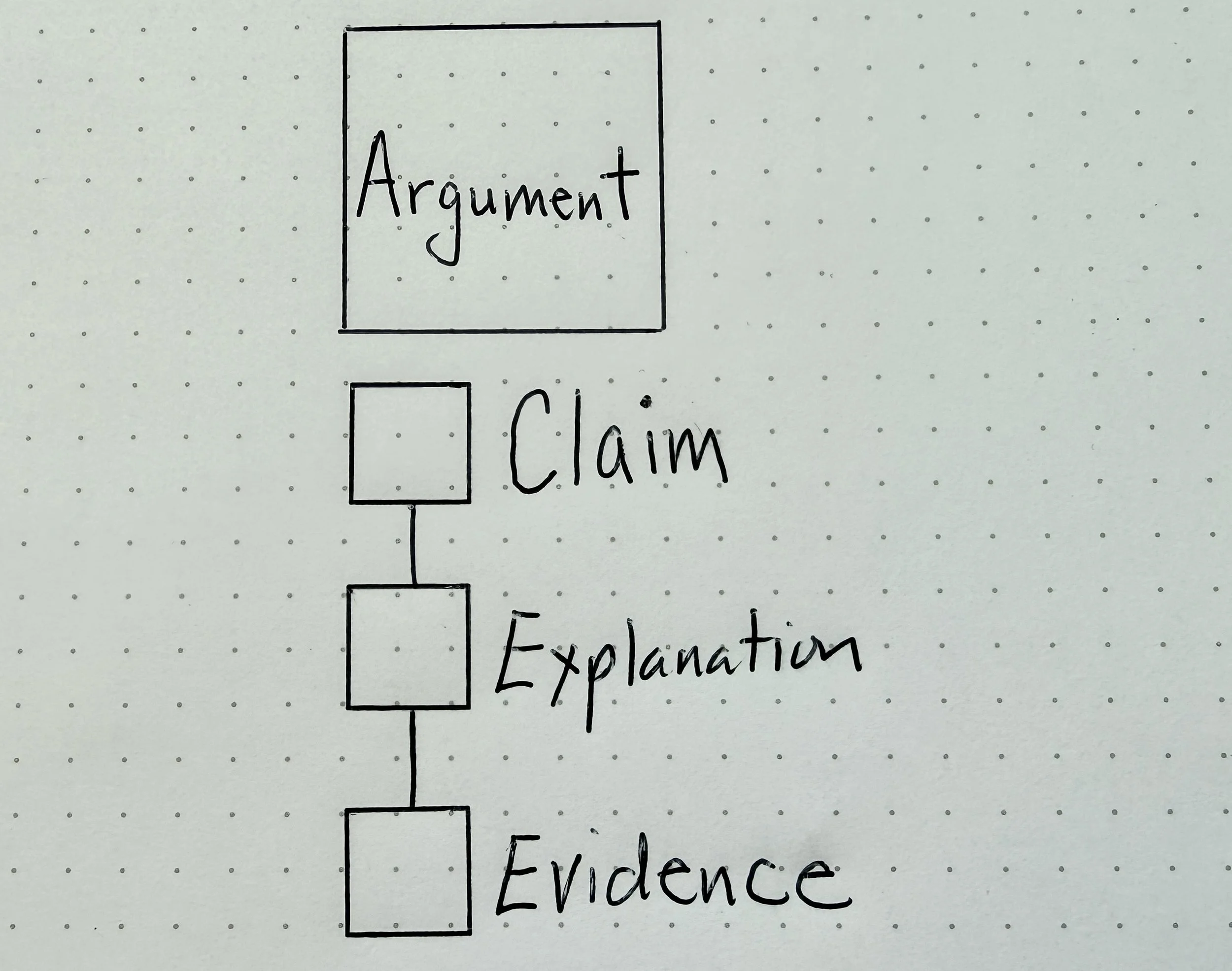
Map 1: This is the basic argument model we started with that year. It is a system with parts. The model was posted on the wall. I referred to the poster during discussions about writing assignments.
At some point early that fall, my Humanities teaching partner and I overheard a social exchange in the hallway between two students. To start the exchange, one middle schooler attempted to stoke a little social conflict. The other student Ian, responded by brushing off the student’s statement, calmly saying “That’s just a claim.”
My colleague and I were a bit surprised by this. We were used to two basic types of social conversations in the hallway, camaraderie and social conflict. Both types could escalate in intensity quite quickly. And yet, here was Ian, removing the air from potential combustion with the phrase, “That’s just a claim.”

Map 2: Ian’s first cognitive move (Is / Is Not List) was to identify his peer’s statement as “Just a claim.” His Is Not was unstated, but easy to figure out.
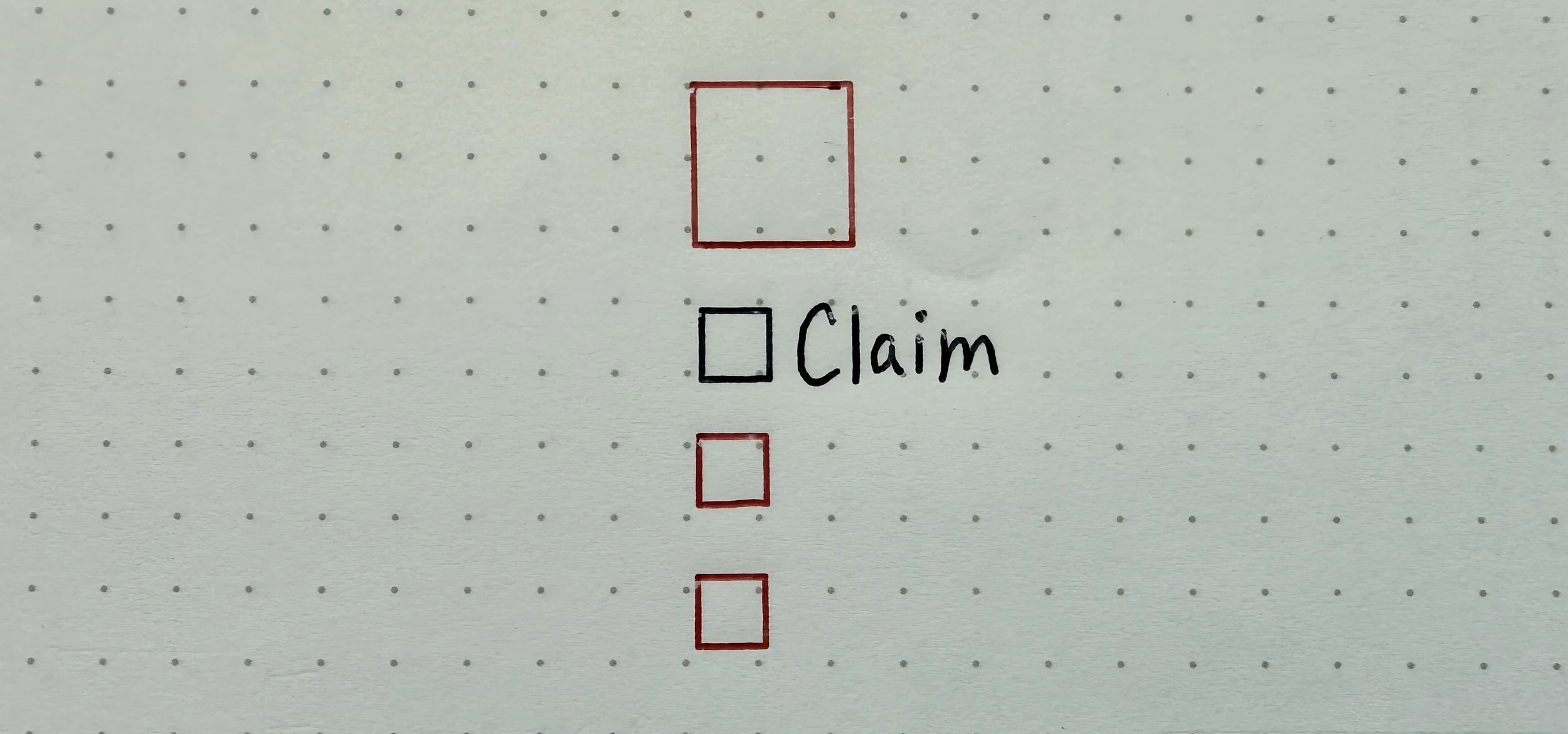
Map 3: Once Ian had claim as a part, he zoomed out to look for the other parts of an argument. Based on his social awareness he hadn’t heard any evidence or explanations to support the claim, so he dismissed his peer’s remarks.
Maps 2 & 3 also begin to demonstrate DSRP dynamics. I’ll get to dynamics in later posts.
While my teaching partner and I thought Ian’s statement was noteworthy, we were too caught up in regular school inertia to meaningfully pause and reflect on Ian’s actions. Later that week, we mentioned the story to the Principal and Assistant Principal in our team meeting. The significance of Ian’s “Just a claim,” statement wasn’t lost on them. One exclaimed, “We could really use transfer like that!” The other continued, “This is really encouraging!”
How I’ve Updated My Mental Model Some Since this Happened
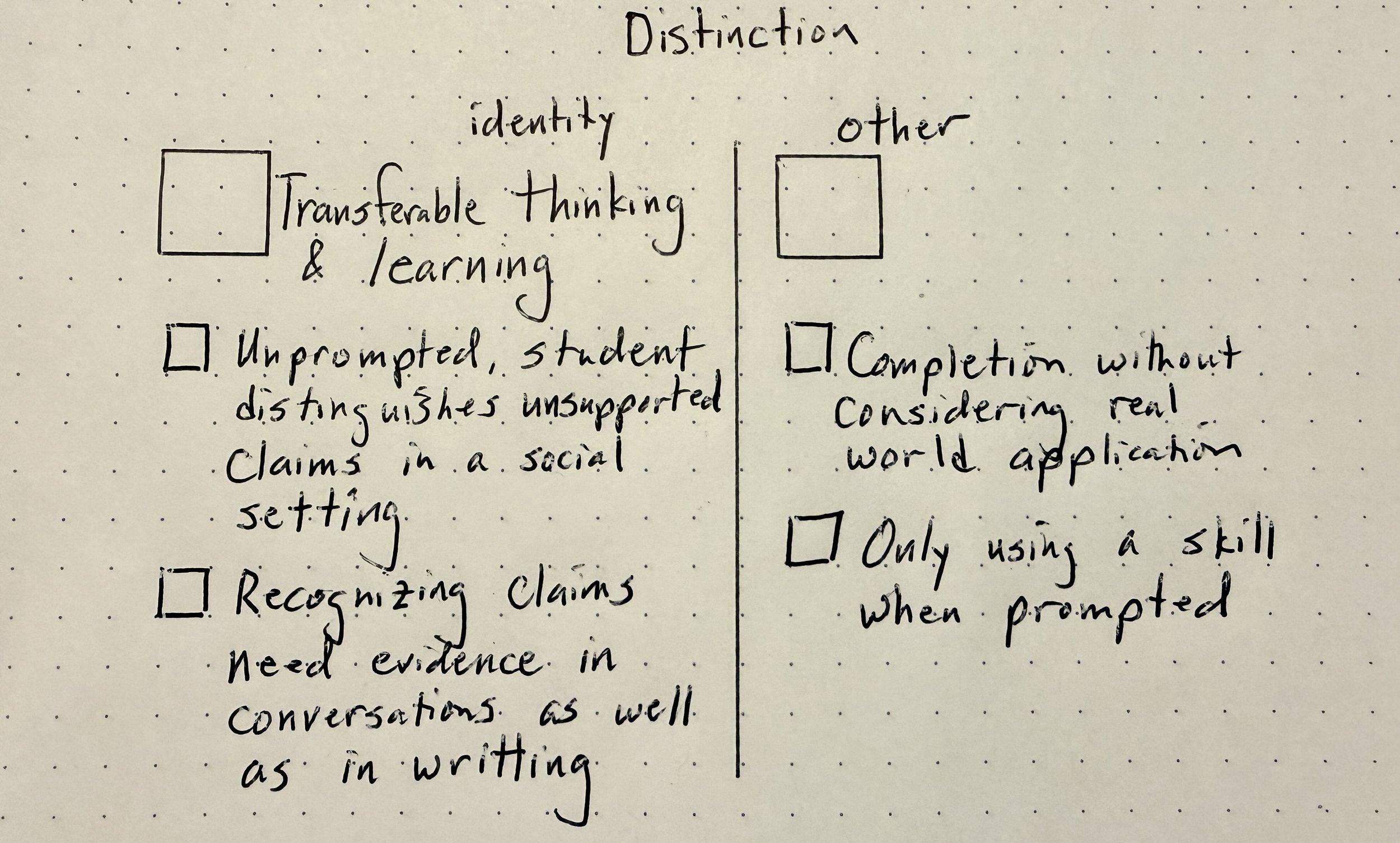
Map 4: This map builds from content in post 4, What is thinking and learning? This Dio List seems so obvious to me now, but I couldn’t organize it when Ian spoke in the hallway that day. I needed a little more observational evidence. That additional observation is the example coming in post 7.
I consider this episode the start of a transformative time in my teaching career. However, when I came across Collective Teacher Efficacy Theory I more fully understood why it happened. First, district and building leaders collaborated on the Civil Discourse framework to get it to match real teacher needs more closely. Then, my teaching partner and I adapted it by adding Toulmin’s Argument model to the mix. As a teacher, this is the only example from my entire career where I can clearly see the evidence supporting intensively aligned collective action from the district level to the classroom. It may of happened other times, but I wasn’t aware of it. Of course school communities try hard to collaborate, but without leaders that practice DSRP it’s really hard to get everyone pulling in the same direction. Usually, collaborative initiatives are more standardized, and then teachers adapt ideas to fit their curriculum. And because most teachers do not practice using research models in real time, the adaptations don’t always directly serve student learning.

Map 6: A Perspective is the interaction between a point and a view. My point here is CTE, the view is the collaborative creation of the Civil Discourse Framework.The resulting perspective is high CTE.
Further Reading/Research
Cabrera Lab Podcast on Existence vs Effect- I enjoyed the basic discussion on argument as Science in this episode.
Focus, by Mike Schmoker. I was introduced to Toulmin’s Argument Model by the first edition of this book.
Another post building on argument coming soon. Until then, I’ll be practicing and rooting for you.